Showing posts with label Historical Mysteries. Show all posts

Wednesday, June 10, 2015

Wednesday Weird: The Drowning Of Ludwig II

Ludwig II was the king of Bavaria in the mid 1800s (1845-1866 for anyone who wants the exact years (you know who you are)).


Good for him, right? Ludwig II loved being king. He loved it so, so much that he took all the money in Bavaria and used it to buy fun things like swan boats. And building an outrageous fairytale castle.


You thought I was kidding about the castle, didn't you? This is Neuschwanstein, the inspiration for Disney's Sleeping Beauty castle

He loved this castle SO MUCH that he thought, hell, why don't I build two more?

He was king, after all, and could do what he wanted. He had no intention of living in them, he just wanted to build them. And in fact would send servants out every day to check on them.

Ludwig II also suffered from OCD and schizophrenia, so after he built his castles and bankrupted the whole country, the nobles decided to finally do something. They stepped in, declared Ludwig II unfit to rule (even gave him a fun nickname: The Mad King (I didn't say it was overly unique or clever)) and took him off the throne.

The end.

And then things get weird.

Three days later, Ludwig II is found dead in a lake near Munich.

Okay, well, sometimes people drown. It happens.

But it doesn't often happen in lakes that are only waist deep.
Or to people (like Ludwig II) who are excellent swimmers.
Or when their royal physicians are in the water next to them.

Why didn't the physician just save him you ask? Oh, because he was dead, too. The good doctor had marks and bruises that looked like someone had strangled him, but Ludwig's body was unmarked.

So, what do you do with a mystery like this? Nothing. You say the former king drowned and wash your hands of it.

Except for the fact that Ludwig had no water in his lungs at all.
Complicating things even more (I know) Ludwig and the doctor had forbidden Ludwig's aides to follow them while they went off to do . . . something. Presumably whatever it was that got them killed. And Ludwig had been known to say, more than once, that he wished to become an eternal enigma to himself and others.

Thoughts or theories?

Wednesday, March 11, 2015

Wednesday Weird: The Sea Peoples

Phew. It's been awhile since I've been able to write up a Wednesday Weird. I always write my blog posts on Sundays, and it's just been a few months where I've had enough free time on a Sunday to write one up (because WWs take research, friends.)

Anyway, today's topic: The Sea Peoples.

1200 BC had quite a few empires slipping into decline--the Hittites, the Mycenaeans and everyone's favorite, the Egyptians.

So, they're already having a rough time of it, and then a huge army of barbarians showed up and laid waste to pretty much everything they touched.


These are the Sea Peoples, and even though it's 2015, we still have no idea who they were.

One of the first places they attacked was Anatolia (modern day Turkey). Anatolia at the time was quite powerful, but king Ugarit received a message from a neighboring king begging for help against a band of unknown attackers.

So, Ugarit, being a good neighbor, sent his army to help out. But, unfortunately it didn't. The Sea Peoples burned the neighboring city to the ground, then for the hell of it (because, I mean, they came all that way) they marched to Ugarit's city and burned it to the ground as well before they disappeared.

A few years later, the same thing happened at Kadesh (modern day Syria). And then they just marched and sailed and burned through civilization so violently that it actually reshaped the landscape.

Eventually they reached Egypt and attacked. And, of course, you'd better believe if the ancient Egyptians built the pyramids they weren't effing around.

The Sea Peoples used massive invasion forces twice, but each time the Egyptians held them off. Finally the Sea Peoples left again. And that was it.


Scholars today have some theories about their identities--maybe they came from Europe, or Asia Minor, or the Balkans. But pretty much anyone's guess is as good as the next, because the only people who ever met the Sea Peoples were too busy fighting and dying to spend any time to take notes or document who they could be or where they came from.

Hell, for all we know, the Sea Peoples are still out there today.
Just biding their time . . .

Wednesday, December 17, 2014

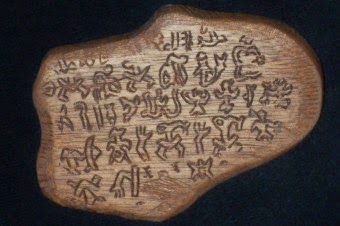
Wednesday Weird: Rongorongo

Easter Island is well known for the giant moai statues and the mysteries surrounding them.

But the moai are not the only mystery found on Easter Island.

Rongorongo is a mystery written language found on tablets on the island. Known as Rapa Nui to the island's inhabitants the language is strange on multiple levels.

The first being that it didn't appear until the 1700s. Some scholars think the language came about when the islanders first saw written language from the Spaniards who hade traveled to their island, but there's just as much support that it could be one of the very few instances of independent inventions of writing in human history.


So the language suddenly appeared in the 1700s and in just two centuries it would be gone again, leaving the mystery as it is today.

Rongorongo is a pictograph writing system. It was found on wooden tablets and other objects, such as a chieftain's spear. Writing was unknown in any of the surrounding islands, which makes its appearance confounding to anthropologists. If no one around you writes, how do you come up with this system on your own?


Despite its recent birth, though, no archeologist, linguist, or scholar has ever been able to decipher the language. The closest any have come is discovering that one of the tablets referred to a lunar calendar.

The problem was that the island's population when it was first discovered was around 4,000, but the ecosystem was suffering and the island was overpopulated. Add to the mix western disease and the slave trade and shortly after that Easter Island would be reduced to a population of 110 by 1877. And the colonizers would decide the strange language was too pagan and would forbid it as a form of communication. Finally, missionaries would destroy the tablets with Rongorongo inscriptions.

Since then, scholars have tried to decipher the text, but any remaining inhabitants would refuse to translate, and the best help they ever got was when one islander, drunk, looked at a tablet and sang a song about fertility.

Only 25 texts survive, and what they hold will continue to be a mystery unless someone, someday, manages to decipher the mystery language. Maybe when that happens, we'll have a final understanding of the more well-known mystery of the moai statues.


Wednesday, December 10, 2014

Wednesday Weird: The Immortal Count Saint Germain

Saint Germain was a count born in the late 1600s (though records on this are still unclear) and who seems to have unlocked the ability to live forever.


Born the son of Francis Racoczi II, Prince of Transylvania, he was supposedly an accomplished alchemist and also claimed to have discovered eternal life. Between 1740 and 1780 Saint Germain, who was quite famous, traveled throughout Europe – and never seemed to age.

Let's break down this mystery man.

He spoke 12 languages
He could play the violin like a virtuoso.
He was an accomplished painter.
Wherever he traveled, he set up an elaborate laboratory, presumably for his alchemy work.
He seemed to have great wealth, but was not known to have any bank accounts.
He dined with friends frequently, but was rarely seen to eat food in public. He subsisted supposedly on a diet of oatmeal.
He had recipes for the removal of facial wrinkles and hair dye.
He was linked to several secret societies, including the Freemasons, the Illuminati and Order of the Templars.

So all of that is pretty impressive, but not, say, impossible for a man of means.
So let's get down to the weirdness.

Officially Saint Germain died in 1784, but he would continue to be seen throughout the 19th century and into the 20th century.

In 1785 he was seen in Germany with Anton Mesmer, the pioneer hypnotist.

Official records of Freemasonry show that they chose Saint Germain as their representative for a convention in 1785.

In the French Revolution in 1789, the Comtesse d’AdhĂ©mar said she spoke with Saint Germain. He allegedly told her of France’s immediate future, as if he knew what would happen.
In 1821, she wrote: “I have seen Saint-Germain again, each time to my amazement. I saw him when the queen was murdered, on the 18th of Brumaire, on the day following the death of the Duke d’Enghien, in January, 1815, and on the eve of the murder of the Duke de Berry.” The last time she saw him was in 1820 – and each time he looked no older than mid-40.

C. W. Leadbeater claimed to have met him in Rome in 1926 and said that Saint Germain told him that one of his residences was a castle in Transylvania.

Thoughts and theories?

Wednesday, June 18, 2014

Wednesday Weird: The Dighton Rock

Sitting in the riverbed of the Taunton River in Berkley Massachusetts, facing the bay, rested the Dighton Rock.


Discovered nearly 300 years ago the 40-ton boulder is covered in puzzling petroglyphs, primarily made up of lines, geometric shapes, and schematic drawings of people. There is also writing on the rock, some of it verified and some of it not.

And English colonist first described the boulder in a writing:

Among the other Curiosities of New-England, one is that of a mighty Rock, on a perpendicular side whereof by a River, which at High Tide covers part of it, there are very deeply Engraved, no man alive knows How or When about half a score Lines, near Ten Foot Long, and a foot and half broad, filled with strange Characters: which would suggest as odd Thoughts about them that were here before us, as there are odd Shapes in that Elaborate Monument


Even before that another colonist drew a picture of the boulder (the drawing is preserved in a British museum), though is picture was not overly accurate since he couldn't see the whole thing due to the tide.


In 1963, due to dam construction, state officials removed the boulder and kept it for preservation.

No one has been able to solve the mystery of the writing on the rock and theories abound about who could have carved the petroglyphs, the more popular theories being Indigenous peoples of North America, who have historically carved petroglyphs in Vermont, ancient Phoenicians, the Vikings, the Chinese or the Portuguese.

Still, after 300 years, the mystery still remains.

Any theories?

Wednesday, May 21, 2014

Wednesday Weird: The Green Children of Woolpit

The Green Children of Woolpit were two children who appeared in the village of Woolpit in Suffolk, UK, in the 12th century. The brother and sister had green colored skin, even though they appeared normal in all other ways. They spoke an unrecognized language and refused to eat anything other than pitch from bean pods.
Eventually, their skin lost its green color. After they learned English, they explained that they were from the “Land of St Martin,” which was a dark place because the sun never rose far above the horizon. They claimed that they were tending their father’s herd and followed a river of light when they heard the sounds of bells. Then they arrived in Woolpit

Read more at http://www.viralnova.com/unsolved-earth-mysteries/#cLzcUUPDF2XVuUuu.99
The Green Children of Woolpit were two children who appeared in the village of Woolpit in Suffolk, UK, in the 12th century. The brother and sister had green colored skin, even though they appeared normal in all other ways. They spoke an unrecognized language and refused to eat anything other than pitch from bean pods.
Eventually, their skin lost its green color. After they learned English, they explained that they were from the “Land of St Martin,” which was a dark place because the sun never rose far above the horizon. They claimed that they were tending their father’s herd and followed a river of light when they heard the sounds of bells. Then they arrived in Woolpit

Read more at http://www.viralnova.com/unsolved-earth-mysteries/#cLzcUUPDF2XVuUuu.99
In the 12th century in Suffolk, England, two children appeared in the village of Woolpit beside one of the wolf pits the village was named after.

They were brother and sister, and though they looked pretty normal, they had green skin, wore strange clothing, and spoke an unknown foreign language.


The people of the village tried to take care of them, but the children refused all food for the first few days until they were finally offered bean pods.

After some time, they learned to eat other foods and when they did, they lost the green color to their skin. The boy was sickly, though, and died shortly after he and his sister were baptized.

After she learned English, the girl, dubbed Agnes, explained that they had come from "St. Martins Land" which was a dark place because the sun never rose far above the horizon and where everything was green. She said that they had ben tending their father's herd when they heard a loud noise, possibly the bells of Bury St Edmunds, and suddenly found themselves standing by the wolf pit.


Sign for Woolpit, created in 1977

The girl would eventually be employed as a servant in Richard de Calne's household where it was reported that she was "vey wanton and impudent". She eventually married and moved away from Woolpit.

So there you go. Kind of a weird little story. Thoughts or theories?
The Green Children of Woolpit were two children who appeared in the village of Woolpit in Suffolk, UK, in the 12th century. The brother and sister had green colored skin, even though they appeared normal in all other ways. They spoke an unrecognized language and refused to eat anything other than pitch from bean pods.
Eventually, their skin lost its green color. After they learned English, they explained that they were from the “Land of St Martin,” which was a dark place because the sun never rose far above the horizon. They claimed that they were tending their father’s herd and followed a river of light when they heard the sounds of bells. Then they arrived in Woolpit

Read more at http://www.viralnova.com/unsolved-earth-mysteries/#cLzcUUPDF2XVuUuu.99

Wednesday, November 13, 2013

Wednesday Weird: Shugborough Inscription

Sometime between 1748 and 1763 the Shepherd's Monument was built on the grounds of Shugborough Hall in Staffordshire, England. It contains a relief sculpture of Nicolas Poussin's painting The Shepherds of Arcadia.


The monument was commissioned by Thomas Anson, but paid for by his brother George Anson.

Which, okay. Nice little monument, but where's the mystery? Where's the weird?

Directly below the mirror image of the painting.

A sequence of letters rest between the letters DM


The letters have never been explained and to this day remain one of the world's most cryptic ciphertexts.

On Roman tombs, DM typically stood for Diis Manibus: dedicated to the shades. But no one has been able to figure out what the remaining letters mean. Some people think maybe they're acrostic (each letter represents the initial letter of a word) but theories abound.

One theory is that the letters are a dedication by George Anson to his deceased wife for the Latin phrase Optimae Uxoris Optimae Sororis Viduus Amantissimus Vovit Virtutibus -- "Best of wives, Best of sisters, a most devoted Widower dedicates (this) to your virtues"

Another theory is that the letters stand for numbers which sum to 2810, the distance in miles from Shugborough to the so-called "Money Pit" on Oak Island in Nova Scotia (another Wednesday Weird post I have in the making).

None of the existing theories, though, whether plausible or just crazy, satisfactorily explain the secret message carved into the stone of the monument.

Thoughts? Theories?

Wednesday, July 24, 2013

Wednesday Weird: Persian Mummy Princess

In the world of archeology, finding a mummy is the shit. I mean, they give you a medal and junk. Well, not really, as far as I know, but you get what I'm saying. You get some mad props if you're an archaeologist and find a mummy.

In 2000, someone tipped off Pakistani police that there was a mummy in a house that the owners were planning to sell on the black market for $20 million dollars and have smuggled out of Pakistan. When they raided the house, it turned out the tip off was right, there was indeed a mummy.

The mummy was 2,600 years old, encased in a carved stone coffin inside a wooden sarcophagus and was wearing a gold crown and mask. An inscription on her breastplate read: I am the daughter of the great king Xerxes. I am Rhodugune.


This was a huge archaeological discovery. No Persian mummy had been found before, especially royalty. And actually mummification had always been thought to be a strictly Egyptian practice.

An incident broke out about who would get to keep the mummy, Iran or Pakistan. So while that was going on, scientists got down to sciencing and closely examined the mummy.


That's when things got weird.

The first thing they noticed was that the grammar on the inscription was terrible. Like maybe the inscriber didn't actually speak ancient Persian very well.

Then they noticed that the coffin itself wasn't ancient. It was actually only about 250 years old.

Like the grammar, the mummification process was a crap job as well. Some of the steps of the process had been completely skipped.

So, at this point, with the hack work, they started to think that maybe the mummy wasn't a princess at all. Maybe someone had dressed up a common mummy as a princess to hopefully garner more bucks on the black market.

BUT! And this is a big but. (heh. Big butts). It turns out the mummy herself wasn't ancient at all. She'd only been dead 2 years.

And she'd been murdered.

It seemed someone had actually murdered a person to make a fake mummy purely to try and sell it on the black market for a crap ton of cash. And there is evidence to show that this wasn't the first time they had done this. They had actually done this three other times as well.

So, not only do you have to worry about being murdered by a stranger, now we have to worry that said stranger will mummify us (crapily) all to make some money.

Wednesday, July 17, 2013

Wednesday Weird: Tomb Treasures

In 2008, archaeologists got a chance to crack a tomb from the Ming dynasty in Shangsi, Southern China. They were the first ones to visit the grave since the occupants funeral.

They'd brought a camera crew to create a documentary as they excavated the tomb. But while they were filming they found something much weirder.

When the were trying to remove the soil encrusting the coffin, a chunk broke off and hit the floor with a metallic clink.

They picked up the object and discovered it was a ring. But not just any ring.

The removed the dirt from the ring and it turned out to actually be a watch. A Swiss watch that had stopped at 10:06 am.


The watch itself was estimated to be 100 years old, buried in a tomb over 400 years old. Watches weren't even invented in the time of the Ming dynasty, and Switzerland wasn't even a country.

So how did this mysterious timepiece find it's way inside an undisturbed tomb?

Thoughts? Theories? Throw them my way!
Related Posts Plugin for WordPress, Blogger...